
There is a form of professional credibility that does not announce itself in press releases or public-facing milestones. It is built, instead, in the quiet accumulation of difficult environments, in the discipline required to keep food systems running on an offshore drilling platform during rough sea conditions, to feed fifty thousand workers daily inside a sprawling steel plant, to bring digital order to cafeteria floors scattered across corporate campuses.
What these environments share is not an industry. They share a logic: that service continuity, structured systems, and people-oriented leadership are the only things that ultimately hold complex enterprises together.
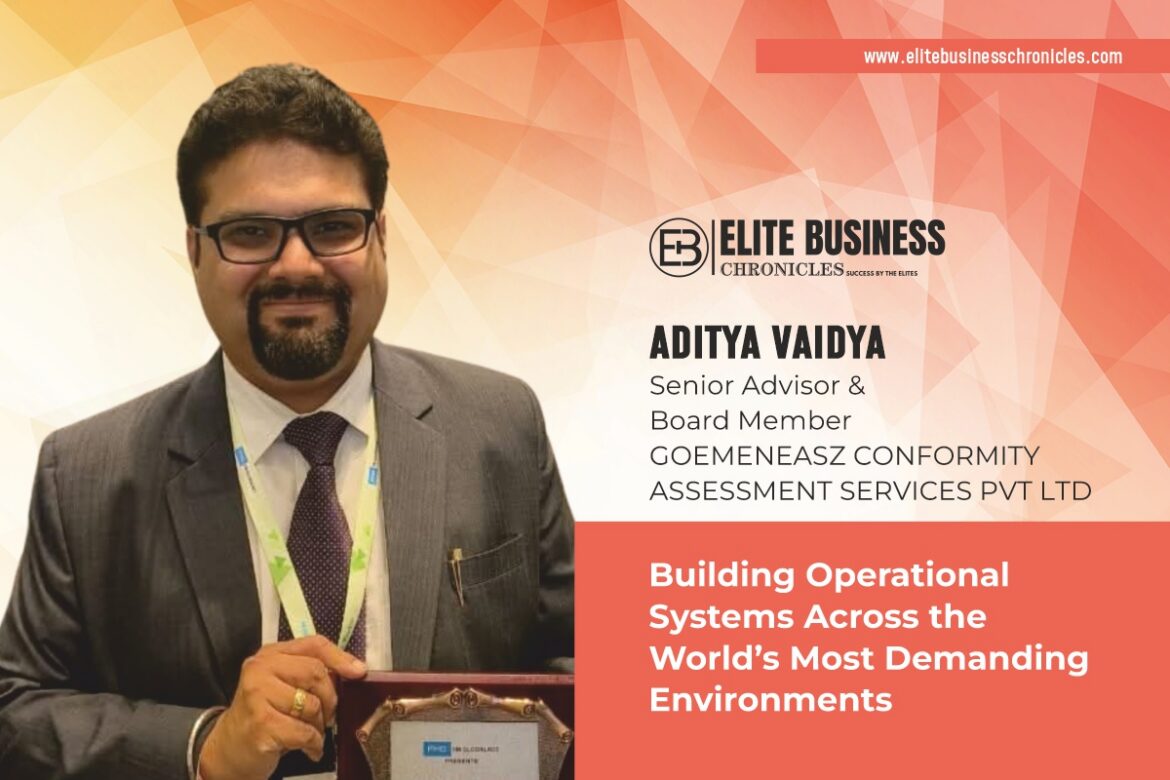
Aditya Vaidya has spent more than two decades working inside exactly these environments. As Senior Advisor and Board Member at Goemeneasz Conformity Assessment Services Pvt Ltd (GCAS), his current role sits at the intersection of food safety, quality systems, compliance advisory, and strategic organizational development. But to understand the professional perspective he brings to that seat, it is necessary to trace a career that began not in a boardroom but in an aviation catering kitchen in Mumbai.
The Foundation in Motion
Aditya’s early professional formation happened within the discipline of hospitality, where execution-driven precision is less a philosophy than a survival requirement. His career began at Oberoi Flight Services, Mumbai, where he worked as a Chef within aviation catering operations. The environment demanded exacting adherence to hygiene protocols, production timing, and quality consistency within high-volume service conditions.
The scope of that systems thinking broadened considerably with his subsequent association with Carnival Cruise Line in Houston, United States. Cruise hospitality operates as a closed system of multicultural teams, continuous service delivery, and logistics frameworks that function across international waters without the safety net of a nearby supply chain. The experience deepened his understanding of hospitality infrastructure requiring synchronized coordination between logistics, workforce management, culinary consistency, and uninterrupted service delivery.
“Hospitality is not merely about service delivery — it is about systems, logistics, people management, and operational continuity functioning together seamlessly.” That insight, absorbed early, would prove foundational to every phase of his career that followed.
Into the Offshore Crucible
The transition into offshore oil and gas operations marked the most formative chapter of Aditya’s professional journey. His initial exposure connected him to projects associated with ONGC Bombay High and the Krishna Godavari Basin, working within execution-led ecosystems supported by globally recognized organizations including Sodexo and Compass Group.
Over time, those assignments expanded across seven major maritime regions: the Arabian Sea, Bay of Bengal, South China Sea, Persian Gulf, Gulf of Mexico, Caribbean Sea, and Sea of Japan. International project exposure brought him into contact with ecosystems connected to Brunei Shell Petroleum through Serikandi Oilfield Services in the South China Sea, and onshore rig environments associated with Kuwait Oil Company in remote desert operations.
Additional exposure extended across ecosystems connected to Petroleum Development Oman, PetroVietnam, Petronas, ExxonMobil, Schlumberger, and Vantage Drilling. Across this period, his professional footprint extended through Oman, Qatar, Kuwait, Singapore, Malaysia, Indonesia, Vietnam, the Philippines, South Korea, Brunei, France, Martinique, and the Caribbean Islands.
A defining characteristic of this phase was the sustained responsibility of leading multicultural workforce environments. Projects required structured coordination across catering and hospitality teams drawn from India, Brunei, Malaysia, Indonesia, Singapore, and across the broader GCC region.
Managing this diversity of professional backgrounds, dietary requirements, communication styles, and workplace cultures within isolated offshore installations required more than logistics expertise. It demanded cross-cultural leadership fluency and the ability to build team cohesion in environments where interpersonal dynamics directly shaped service continuity and workforce welfare.
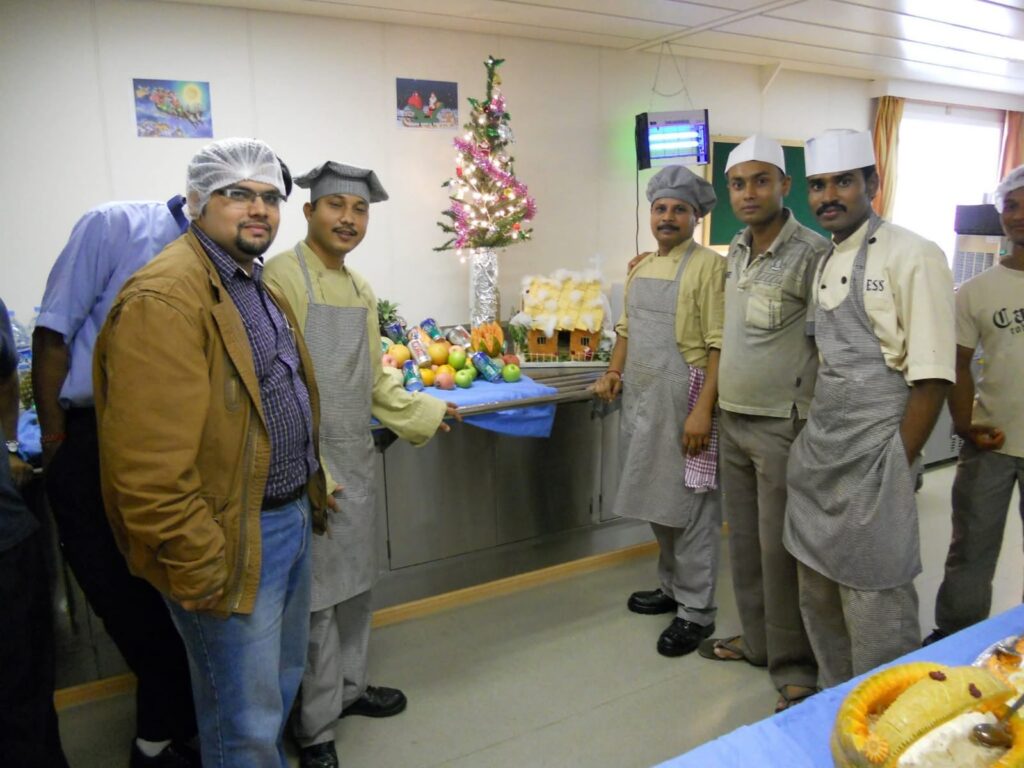
Offshore installations impose a particular kind of pressure that conventional hospitality environments simply do not replicate. Weather conditions disrupted supply logistics. Provisions had to be planned across extended rotations with limited flexibility for resupply.
Teams operated for weeks and sometimes months within confined, physically demanding environments, removed from families, communities, and the social anchors that most people rely on to sustain motivation. “The challenge was not merely operational, it was human.”
Ensuring discipline while maintaining motivation, emotional balance, and service quality in those conditions required a form of leadership that combined process thinking with genuine empathy. Composure under uncertainty became as essential as logistics competence. Those environments, Aditya reflects, shaped his understanding of resilience and structured execution more than any classroom or credential could, and instilled a conviction that leadership, at its most essential, is the practice of holding people and systems together simultaneously.
Systems at Scale
Returning to India, Aditya brought that offshore execution discipline into large-scale domestic environments of a different but equally demanding character. Through his association with Sakthi’s Kitchen Pvt Ltd, he managed institutional catering operations across a portfolio of premier educational institutions, including multiple Indian Institutes of Technology, Indian Institutes of Management, the Visvesvaraya National Institute of Technology Nagpur, Sardar Vallabhbhai National Institute of Technology Surat, and the Indian Institute of Science Education and Research Berhampur.
Institutional food service at this level requires structured oversight across workforce deployment, procurement systems, hygiene compliance, food safety frameworks, vendor coordination, and production planning, all at enterprise scale.
Among the more execution-intensive assignments in his career was his work at JSW Steel’s Vijayanagar Works Plant in Bellary. According to Vaidya, the project involved the management of 18 industrial canteens, coordination of approximately 240 catering personnel, and food service systems catering to more than 50,000 people daily.
The infrastructure-focused nature of the assignment required process discipline across logistics, procurement, manpower planning, food production, hygiene management, and service continuity, with no tolerance for disruption.
His engagement with LUFT – The Air introduced a strategically distinct dimension to this phase. The assignment centered on backend operational structuring within a premium hospitality environment, encompassing SOP architecture across both front-of-house and kitchen functions, the design of Food and Beverage service workflows, and kitchen process standardization calibrated for consistency and quality.
Bar operations frameworks were developed and embedded alongside structured training systems designed to ensure workforce proficiency at every service tier. Vendor ecosystem coordination secured supply continuity aligned with the property’s standards, while experience consistency systems ensured that the quality of every guest interaction was underwritten by disciplined back-end infrastructure rather than left to individual improvisation.
The Digital and Compliance Frontier
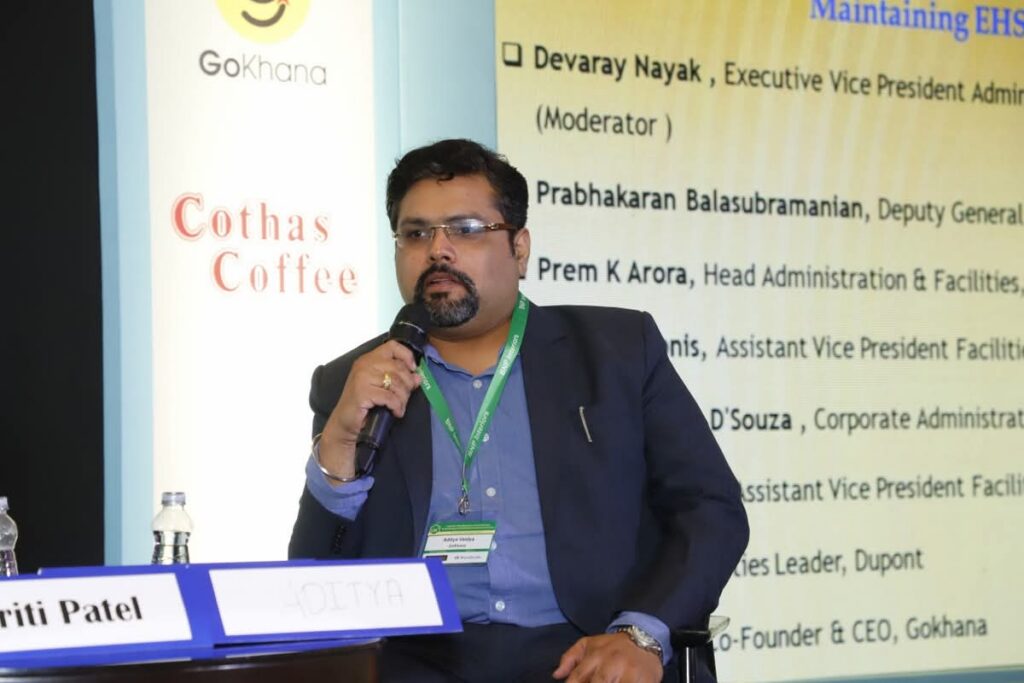
As the food service industry began evolving through technology-driven consumer behavior, Aditya’s professional exposure moved accordingly. His work with GoKhana across Maharashtra and Gujarat positioned him within a new kind of food ecosystem: digitally integrated cafeterias serving corporate parks, business parks, and technology campuses through contactless ordering systems, food brand integrations, and end-to-end cafeteria management infrastructure.
A key aspect of the assignment involved aligning reputed food brands and curated dining concepts to create streamlined, experience-oriented workplace food ecosystems. The experience reinforced a perspective he holds with particular conviction.
“The future of hospitality lies in achieving the right balance between operational efficiency enabled through technology and authentic human engagement that remains central to meaningful service experiences.” Technology, in his reading, is not a replacement for the human dimension of hospitality but an amplifier of it. That philosophy translated naturally into his current association with Goemeneasz Conformity Assessment Services Pvt Ltd.
Established in 2004 under the leadership of Atul Shirodkar, who brings more than two decades of experience in certification and quality ecosystems, GCAS operates across conformity assessment, product certification, industrial inspection, testing, auditing, quality systems, and compliance advisory.
CGAS’s service portfolio spans CE Marking, UL Compliance, ISO System Certifications, HACCP Assessments, Safety Audits, and Project Management Compliance Services, with offices in Mumbai, Pune, and Romania. For Aditya, the association extended his professional lens into accreditation systems, industrial compliance frameworks, and strategic industry engagement.
Website: www.gcasindia.com
Professional Contact: aditya.vaidya@goemeneaszindia.com
The Philosophy of Quiet Leadership
Running beneath every phase of Aditya’s career is a leadership philosophy that prioritizes depth over display. Its principles are consistent: process discipline, execution accountability, adaptability, and respect for people. He believes systems are extremely important, but people ultimately drive systems. In his view, leadership is fundamentally about responsibility. Not the visibility that often gets mistaken for it, but the accountability and consistency that sustain organizations during uncertainty.
He is equally direct about what the modern hospitality leader must carry. In his view, meaningful leadership in the sector requires process depth, emotional intelligence, resilience, adaptability, and systems thinking, alongside the humility to recognize that hospitality environments are built collectively through every layer of contribution. Leaders who understand this, he argues, create workforce environments where teams feel respected, supported, and aligned with organizational goals.
“Respect systems, remain disciplined, continuously upgrade your skills, and value consistency over short-term recognition.” That conviction informs a professional profile that extends beyond execution roles into intellectual contribution. Aditya is the author of Rise of Cloud Kitchens In India with Global Cuisine, published by Notion Press, which examines the evolving cloud kitchen ecosystem and the integration of global cuisine trends within India’s food service industry.
His academic foundation spans an MBA in Shipping and Logistics Management from Kazian School of Management, a graduation in Hotel Management from Oriental School of Hotel Management, and an International Diploma in Hospitality Management from the American Hotel and Lodging Educational Institute. His certification portfolio covers food safety management systems through Lead Auditor ISO 22000:2018 accreditation with TÜVNORD, quality management through Lead Auditor ISO 9001:2015 accreditation with BSI Group, occupational health and safety through NEBOSH, and food safety auditing through the Quality Council of India, among others.
Building Forward
In February 2026, Aditya Vaidya received the Strategic Leadership Award from Insights Success at New Delhi, recognition that acknowledged his contribution across leadership, hospitality systems, institutional food ecosystems, and multidisciplinary professional environments. He receives the milestone with characteristic restraint, viewing it as confirmation not of individual achievement but of what structured, long-term professional commitment can produce.
Looking ahead, Vaidya believes India is entering a phase where businesses will increasingly recognize the strategic value of globally aligned systems infrastructure and structured compliance ecosystems.
Through his role at GCAS, he aims to contribute toward strengthening awareness around process quality, compliance systems, food safety infrastructure, and execution discipline. He also sees continued opportunity to contribute across consulting, hospitality systems, and strategic advisory platforms where multidisciplinary experience can create meaningful value. “I believe lasting professional impact is created not through visibility alone, but through the ability to build systems, strengthen environments, and contribute toward sustainable operational progress over time.” It is a fitting summation of a career that was never built around announcement, but has consistently been built around execution across seas, campuses, factory floors, and compliance platforms, one system at a time.