


There is a tension at the heart of every classroom that most people never see. On one side stands rigor: the demand for measurable outcomes, analytical skill, and intellectual discipline. On the other stands relationship: the human work of trust, belonging, and emotional safety. For decades, education has treated these forces as competing priorities, as though caring deeply for a student and challenging them relentlessly cannot share the same lesson plan.
Cynthia Valenti rejects that division. As an Educator at Central High School, she has spent her career proving that the most transformative learning happens precisely where structure and care converge. Across alternative education settings, special education classrooms, and college-preparatory environments, Valenti has built a body of work grounded in a single conviction: “Rigor without relationship is hollow, and support without challenge is incomplete.”
Her path from frontline case manager to instructional leader, curriculum specialist, and mentor reflects an educator who has never confused motion with meaning. Every role she has held has been shaped by the same question: how do you build spaces where students feel affirmed, valued, and pushed toward meaningful growth all at once?
The Whole Child Across Every Setting
Valenti’s understanding of education was forged in environments that resist simplicity. Her early career included work in alternative education at Camelot, where she learned that academic struggles are frequently rooted in grief, instability, trauma, and fractured trust in institutions. Students in those settings taught her that a lesson plan means nothing if a young person does not first feel safe enough to engage with it.
That foundation carried forward into her special education work, where she developed individualized education plans, led IEP and 504 meetings, coordinated behavior supports, and navigated the procedural demands of compliance. Valenti approaches that work with a clear principle: the legal framework tells educators what support a student is entitled to receive, but relationship and observation reveal who that student actually is.
“No child should ever be reduced to a document, a diagnosis, or a set of accommodations,” she states. Good special education, in her view, honors both the letter of the law and the dignity of the person.
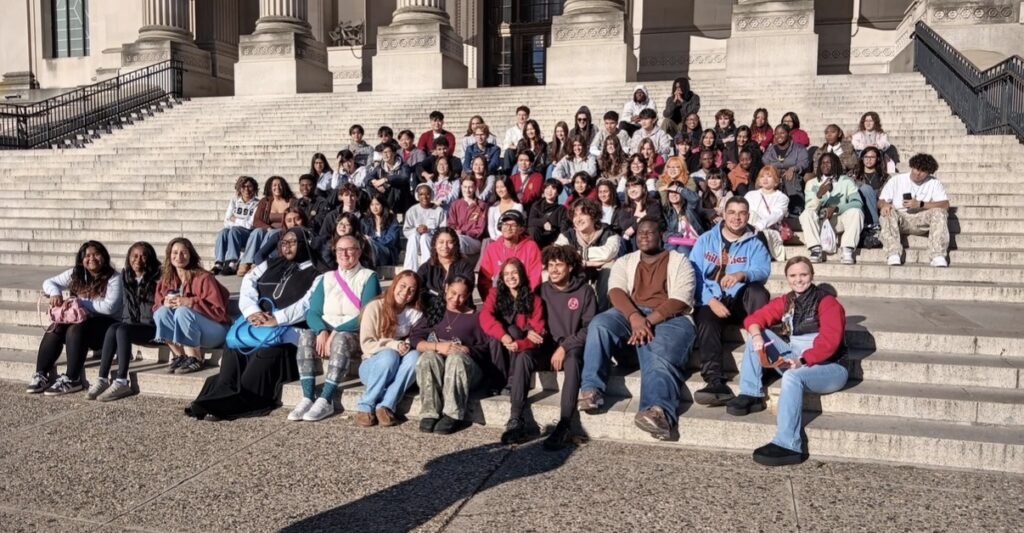
When she moved into college-preparatory classrooms at Central High School, the landscape shifted but the philosophy held. Students in advanced settings may appear more externally successful, yet they still carry emotional, social, and identity-based needs that directly affect learning.
Whether guiding seniors through Hamlet, supporting learners with individualized goals, or coaching students through college essays, Valenti builds environments where high expectations and deep connection operate as partners rather than opposites.
Curriculum as Inquiry
Inside her classroom, Valenti designs a curriculum that treats literature not as a fixed canon to be absorbed but as a site of inquiry. She intentionally teaches works such as Hamlet and Beowulf alongside translated, African, post-colonial, and global literature because she wants students to understand that literature is never neutral. Canonical texts matter, but they are not the only stories that define intelligence, heroism, truth, or civilization.
This comparative framework pushes students toward more sophisticated questions: Whose perspective is centered? Whose experience is omitted? What assumptions about gender, race, class, power, or identity are embedded in the story? When students encounter multiple literary traditions in conversation with one another, they begin to question inherited narratives rather than simply absorb them. Literature becomes a form of critical investigation rather than memorization.
Valenti extends this approach through interdisciplinary units that blend literature with psychology, media, history, and contemporary social issues. In her view, real understanding rarely happens inside one silo. When students study a text only as English content, they may learn literary terms.
When they study it across disciplines, they learn how language, behavior, systems, and history interact. That raises rigor because students must transfer understanding, synthesize perspectives, and engage with complexity.
Just as importantly, this framework builds intellectual empathy. Students begin to see that people’s actions and beliefs are shaped by context, trauma, culture, institutions, and power structures. They become better at interpreting not only literature but also rhetoric, media, and the world around them. Valenti describes the goal as helping students “read beyond the page,” equipping them to analyze narratives in news, politics, technology, and social life with nuance and ethical awareness.
Structure Meets Soul
Beyond the classroom, Valenti has held a constellation of leadership roles that demand organizational precision and emotional intelligence in equal measure. As Grade Level Chair, Yearbook Sponsor for a large senior class, curriculum specialist, and club sponsor, she has consistently built systems that people can trust: clear expectations, organized processes, proactive communication, and thoughtful planning.
Yet she is equally clear that schools are human spaces, and human spaces require flexibility. “The best leadership is not rigid. It is grounded. It knows when to hold the line and when to pivot,” she explains. Her phrase “structure meets soul” captures this philosophy. Students and educators do their best work in environments that are, in her words, “organized, intellectually serious, and emotionally safe.”
Her approach to collaboration reflects the same discipline. Valenti distinguishes authentic collaboration from shared labor. Among educators, it means planning together, reflecting honestly, exchanging feedback without defensiveness, and refining practice in response to student needs.
Among students, it means listening closely, challenging ideas respectfully, and contributing with integrity. She points to Socratic seminars, peer review, public speaking, AP Capstone support, and yearbook production as spaces where collaboration operates as “a discipline of communication and accountability, not just a classroom arrangement.”
This commitment extends to mentoring pre-service teachers, where Valenti teaches reflection as a rigorous habit of mind rather than a quick act of self-evaluation. She pushes emerging educators past surface questions like “What went well?” toward deeper interrogation: What assumptions shaped my choices? What patterns do I notice in my thinking? Where was I effective, and where was I reactive?
For Valenti, a reflective teacher does not simply review a lesson. They examine the implications of their decisions, the students they may have reached or missed, and the beliefs beneath their practice.
Relational Intelligence as Leadership
At the core of Valenti’s work is a concept she treats as both pedagogical tool and leadership philosophy: relational intelligence. She defines it as the ability to read people accurately, build trust intentionally, and respond in ways that move both learning and culture forward.
In the classroom, this is foundational. Students take risks, persist through challenges, and accept feedback when they feel respected and understood. As a leadership practice, it shapes how she communicates, mentors, collaborates, and handles conflict.
“Strong relationships do not lower standards. They make high standards sustainable,” Valenti states. Whether working with students, colleagues, families, or pre-service teachers, she leads with a combination of warmth, clarity, and integrity.
This relational grounding also informs her approach to data. Valenti believes data should function as “a flashlight, not a hammer.” It can reveal patterns, gaps, and growth points that matter, but it is never sufficient on its own. Culturally responsive teaching, in her framework, requires asking not only what the numbers say but what they fail to capture. Which students are disengaging, and why? How are culture, identity, access, language, confidence, or trauma influencing outcomes? Data should sharpen responsiveness, not flatten understanding.
When asked what qualities she considers indispensable for today’s educators, Valenti names adaptability, relational intelligence, cultural responsiveness, reflective discipline, and moral steadiness.
Content expertise still matters deeply, she notes, but it is no longer enough on its own. The strongest teachers she knows are intellectually curious and emotionally grounded, consistent but not inflexible, compassionate but not permissive. “How you show up matters just as much as what you know,” she adds.
Truth-Seeking Over Winning
Valenti’s commitment to intellectual honesty finds a public expression through her co-sponsorship of Politics Central, a student forum dedicated to dialogue on pressing social and political issues. In an increasingly polarized climate, she observes that many students have absorbed the idea that discussion is about dominating, winning, or sounding the smartest. She teaches the opposite.
Thoughtful civic discourse, in her model, requires curiosity, evidence, listening, and the willingness to revise one’s thinking when presented with stronger reasoning. She wants students to distinguish between opinion and argument, between reaction and analysis, between certainty and inquiry. Literature serves as a powerful entry point for this work because it trains students to wrestle with ambiguity, perspective, and motive.
“Truth seeking is not weakness. It is rigor,” Valenti asserts. “The goal is not to defeat another person. The goal is to think more honestly, more clearly, and more responsibly together.” This is the same mindset she brings to her English classroom, where Socratic seminars and student leadership spaces operate on the principle that clarity of thought is a shared responsibility.
A Vision Beyond the Page
Valenti’s long-term vision for English education is both ambitious and grounded. She envisions classrooms that remain deeply human while becoming more interdisciplinary, globally conscious, and relevant to the realities students navigate.
The future, in her view, lies in blending literary study with media literacy, civic discourse, cultural analysis, and thoughtful technological integration. She calls for more exposure to literature beyond the classroom walls, including viewing plays and visiting museums and settings that hold significance within texts.
Technology plays a purposeful role in this vision. Valenti’s work has included integrating digital tools such as Google Classroom, makerspace technology at TECH Freire Charter School, and public-facing student projects. She values digital fluency as essential preparation for a world shaped by technology. But she is careful that it never replaces the human core of literature and storytelling.
Even as she explores AI and digital literacy, Valenti remains committed to preserving what she calls the slow, reflective, relational work of reading and discussion. The goal is not to replace thinking but to enhance students’ ability to research critically, revise meaningfully, collaborate effectively, and express ideas with greater sophistication.
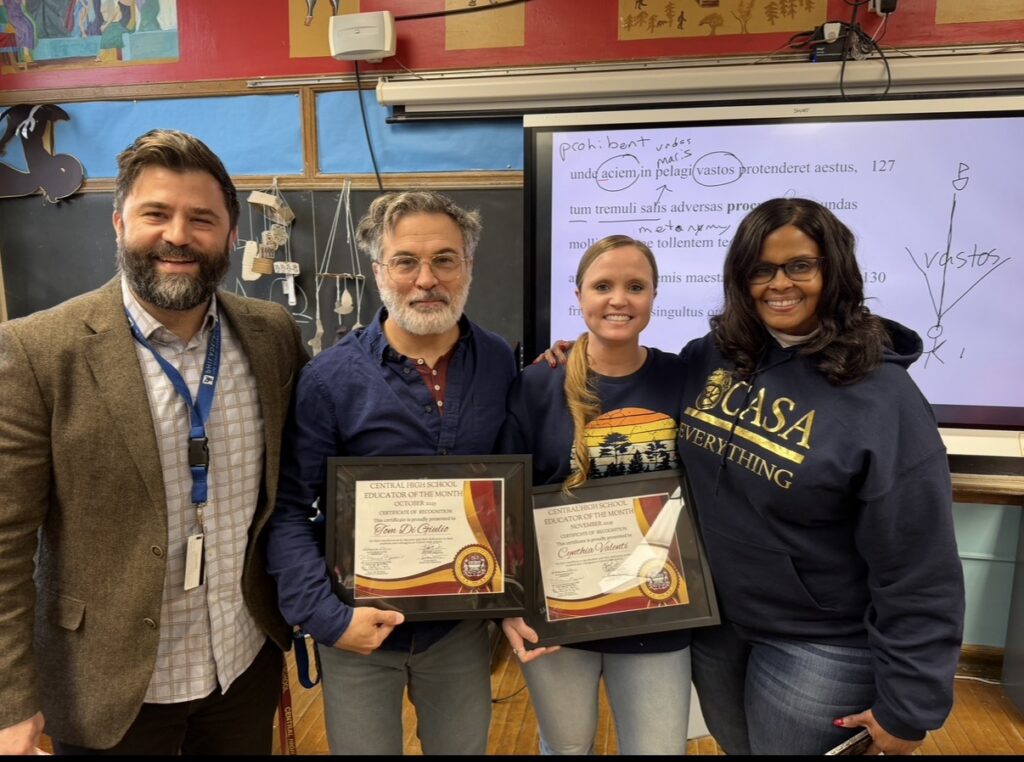
Her career has been affirmed by recognitions that, in her telling, matter not simply as accolades but as evidence that relationship-driven, student-centered teaching still has power. Valenti holds an M.Ed. in Integrated Curriculum and has been named Central High School Educator of the Month, received the KDP President’s Scholarship, served as a Founding KDP Seal of Approval Reviewer, and been recognized as a “Top Visionary Leader Shaping the Future of Education.”
Yet the truest measure of her work is not found in any title or award. It is found in the students who leave her classroom carrying something that outlasts a transcript. Valenti’s mission has never been simply to help students perform well in school. It has been, in her words, to help them grow into “thoughtful, articulate, resilient people who know their voices matter.”
In a profession defined by complexity, Cynthia Valenti continues to prove that when structure and soul converge, the classroom becomes something far more powerful than a place of instruction. It becomes a place of transformation.