

The speed at which enterprises adopt new technology has never been the problem. The problem has always been what happens after adoption, when systems go live, decisions are automated, and the consequences of poor design begin to surface in customer experience, regulatory scrutiny, and institutional credibility.
For decades, the response to this problem followed a predictable pattern. Build first, verify later. Ship fast, fix faster. Quality was the last gate, not the first principle. That pattern is breaking down.
As artificial intelligence embeds itself into the core of enterprise operations, and as digital platforms become the primary interface between organizations and the people they serve, the traditional model of quality as an end-stage checkpoint has become structurally inadequate. The stakes are no longer about catching bugs before a release. They are about ensuring that intelligent systems behave fairly, that data pipelines maintain integrity, and that automated decisions can be explained and defended.
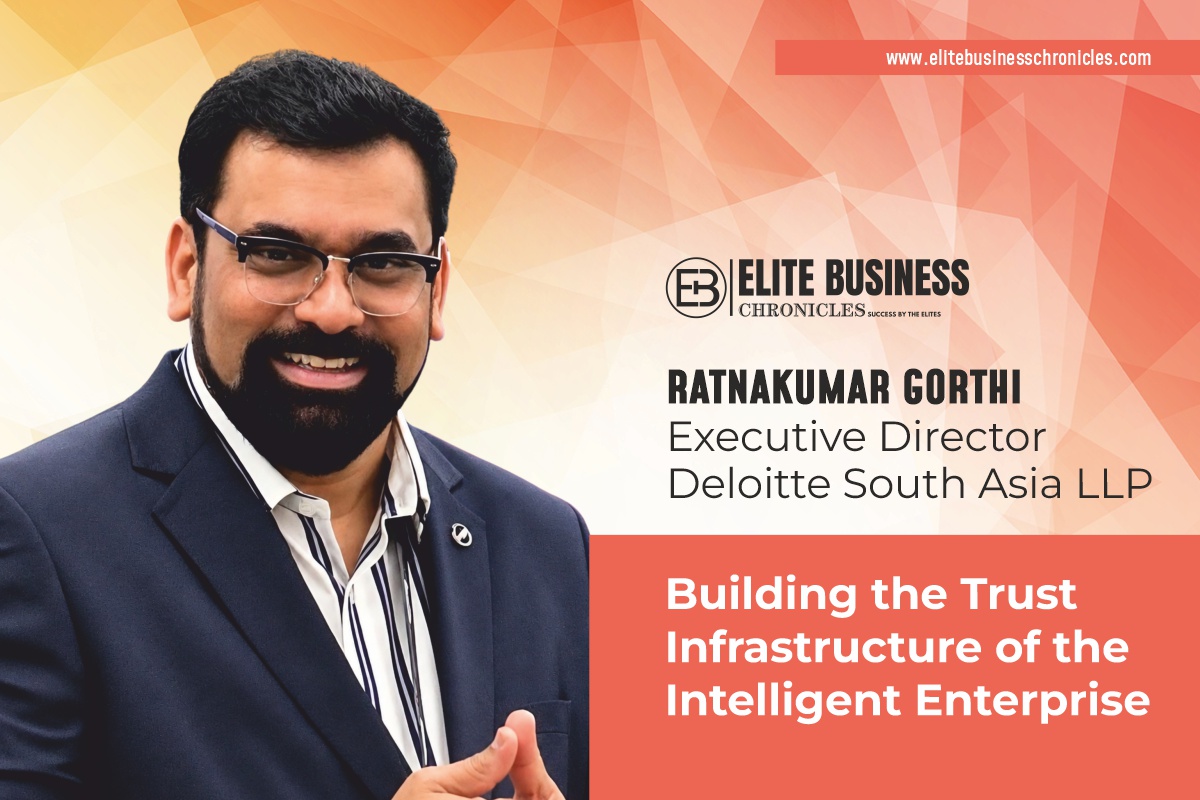
It is in this environment that Ratnakumar Gorthi, Executive Director and Chief Disruption Officer for Quality Engineering at Deloitte, has spent nearly three decades building a case for something more ambitious: quality not as a function, but as a foundational discipline of enterprise strategy. In his view, the organizations that will define the next decade are not simply those that adopt the most advanced technology. They are those that learn to trust it. “Technology drives change, strategy defines direction, but quality ensures that transformation is trusted, scalable, and sustainable.”
The Shifting Mandate
For most of the history of enterprise technology, quality, business strategy, and technology operated in well-defined lanes. Technology teams built systems. Business leaders set growth targets. Quality teams verified that what was built functioned as specified. The arrangement was efficient in its simplicity, and largely sufficient in a world where software releases were infrequent and digital systems remained peripheral to core business operations. That world no longer exists.
Digital platforms have become the operating backbone of modern enterprises. Banking transactions, supply chain networks, healthcare delivery, and e-commerce now run on complex, interconnected digital ecosystems. In this environment, Ratnakumar observes, even a minor system failure carries consequences that extend well beyond the technical.
A defect in a banking platform is not merely a software problem. It is a reputational event. A failure in a healthcare application is not an IT incident. It is a patient safety issue. The cost of poor quality has migrated from development budgets to enterprise risk registers.
This shift has elevated Quality Engineering from an operational function to what Ratnakumar describes as a strategic capability. His framework for understanding this elevation rests on three interconnected pillars.
The first is alignment with business value creation. Quality can no longer be evaluated in purely technical terms, as test pass rates or defect counts. Organizations must measure how system reliability affects customer experience, regulatory compliance, and revenue continuity. For industries where software defects translate directly into financial and reputational risk, this alignment is not optional. It is the minimum requirement for sustainable operation.
The second pillar is the use of intelligent technology to reshape how quality is achieved. Advances in automation, AI-driven testing tools, and real-time observability platforms now allow organizations to move beyond reactive defect detection toward predictive quality management. In Ratnakumar’s view, this shift, from finding problems after they occur to anticipating them before they surface, represents the most consequential change in the discipline in a generation.
The third pillar reframes quality as an enabler rather than a constraint. When Quality Engineering is embedded within DevOps practices and platform engineering, it does not slow innovation. It accelerates it, by giving development teams the confidence to experiment. By integrating intelligent automation and governance into delivery pipelines, enterprises can move faster precisely because quality has been designed in from the start.
Together, these pillars form the basis of Ratnakumar’s central conviction: that the future enterprise will succeed not through technology adoption alone, but through its ability to institutionalize quality as a strategic discipline.
Rearchitecting from the Inside
At Deloitte, Ratnakumar’s mandate as Chief Disruption Officer for Quality Engineering is not to maintain the function as it exists. It is to rearchitect it for a world that bears little resemblance to the one in which traditional QE practices were designed. His approach is organized around three forward-looking priorities, each addressing a distinct dimension of the challenge.
The first is the shift from conventional automation to what Ratnakumar describes as Agentic AI-driven Quality Engineering. Traditional automation frameworks, however sophisticated, operate on predetermined rules. They execute defined scenarios and flag deviations from expected behavior. They do not learn. Agentic AI changes this.
By enabling quality systems to autonomously generate test scenarios, adapt to application changes, and continuously optimize validation processes, the function moves from static frameworks to dynamic, learning-driven quality ecosystems. The practical implication is significant: organizations can reduce manual intervention while simultaneously expanding the coverage and precision of their quality processes. In Ratnakumar’s framing, this is not an incremental improvement. It is a structural transformation of how quality operates.
The second priority addresses the challenge of digital trust in an era where AI drives an increasing share of enterprise decision-making. As algorithmic systems take on more consequential roles, concerns around bias, data integrity, and transparency are no longer abstract. They are central to how organizations are governed and how they are perceived.
Ratnakumar’s response is to position Quality Engineering as the custodian of trust within this environment, validating AI model behavior, ensuring fairness and explainability in automated decisions, and embedding data governance practices into the QE lifecycle. In this framing, QE becomes the mechanism through which enterprises demonstrate that their intelligent systems operate responsibly.
The third priority is resilience through AI governance and adaptive quality frameworks. In environments where systems are continuously evolving, Ratnakumar argues, resilience cannot be treated as a feature added late in development. It must be built in from the foundation, through predictive analytics, real-time observability, and governance controls that allow organizations to detect vulnerabilities early and respond to disruptions before they cascade. This transforms Quality Engineering into what he calls a proactive, intelligence-led discipline, one focused not on catching failures after they occur but on preventing the conditions that allow failures to take hold.

The GenAI Inflection Point
Not every technological advance redefines the discipline it touches. Most improvements are additive, expanding capacity or reducing friction within frameworks that remain fundamentally unchanged. Generative AI, in Ratnakumar’s assessment, is not that kind of advance. It is, in his view, a defining inflection point, one that does not simply improve what Quality Engineering does but challenges the assumptions on which the function was built.
The limitations of traditional testing approaches have become increasingly visible as enterprise architectures have grown more complex. Manually crafted test cases and rule-based automation frameworks were designed for environments that changed slowly and predictably. Today’s reality is different. Cloud-native architectures, microservices, continuous delivery pipelines, and continuously evolving user experiences create a landscape where static testing models struggle to keep pace. By the time a test suite is built to cover a given state of the system, the system has already changed.
Generative AI addresses this problem at its root. By interpreting functional requirements, user journeys, and system interactions, AI-driven frameworks can automatically generate high-quality test scenarios, synthetic datasets, and automation scripts at scale. More importantly, these frameworks can adapt when applications change, self-correcting as interfaces evolve or workflows shift. Ratnakumar sees this capability as resolving one of the most persistent structural problems in quality automation: the maintenance burden. Traditional automation frameworks require constant human upkeep to remain effective. AI-driven systems reduce that burden by design.
The second dimension of GenAI’s impact is the shift from reactive validation to predictive intelligence. By analyzing patterns across historical defects, code changes, runtime telemetry, and user behavior, AI models can identify areas of elevated risk before failures materialize. Teams can prioritize testing efforts with precision, focusing resources on the components most likely to fail rather than applying uniform coverage across the entire system. In Ratnakumar’s framing, this represents a decisive move from defect detection to defect prevention, improving both the efficiency of quality processes and the reliability of the systems they protect.
Looking further ahead, Ratnakumar envisions a future of self-learning quality ecosystems in which multiple AI agents operate collaboratively across the entire software lifecycle. From development and testing through to production monitoring, these agents continuously ingest real-world data, learn from system behavior, and refine testing strategies without human intervention. The result is a quality framework that does not merely keep pace with change but strengthens itself through exposure to it.
He is equally clear, however, that the rise of Generative AI introduces a layer of responsibility that Quality Engineering cannot afford to overlook. As enterprises depend more heavily on AI-driven decision-making, QE must extend its scope to validate the AI systems themselves, ensuring fairness, transparency, and responsible data usage. In his view, this makes Quality Engineering not merely a productivity function but the guardian of trust in the intelligent enterprise.
Engineering Trust at Scale
Of all the ideas Ratnakumar has developed across nearly three decades in enterprise technology, the concept he returns to most consistently is one he describes as engineering trust at scale. It is the intellectual core of his work and understanding it requires stepping back from the conventional definition of quality.
Traditional Quality Engineering is concerned with functional correctness and performance. A system either behaves as specified or it does not. A process either meets its performance threshold, or it falls short. These are meaningful measures, but Ratnakumar argues they are no longer sufficient.
In an era defined by AI-driven decisions, interconnected platforms, and data-intensive operations, the question enterprises must answer is not only whether a system works, but whether it can be trusted. Trust, in his framing, encompasses dimensions that functional testing was never designed to address security, privacy, fairness, explainability, and regulatory compliance.
The practical implication of this shift is significant. Trust cannot be retrofitted. It must, as Ratnakumar puts it, be designed in, not tested later. Systems must be built on secure-by-design principles from the outset.
AI models must be validated for bias and fairness throughout their development, not audited after deployment. Data pipelines must maintain integrity and governance from the point of ingestion through to consumption. The moment trust becomes an afterthought; it becomes a liability.
Making trust engineering operational, however, requires resolving a challenge that many organizations find difficult to overcome. Trust is often perceived as abstract, a matter of culture or reputation rather than engineering. Ratnakumar’s response is to insist on its measurability.
Organizations can and must translate trust into quantifiable metrics: security vulnerability indices, data privacy compliance scores, AI bias detection rates, system resilience benchmarks, and customer trust indicators that capture reliability perception and incident response effectiveness. When trust is expressed in these terms, it becomes governable.
He also introduces the concept of trust observability, the practice of leveraging telemetry, analytics, and AI to monitor trust signals continuously and in real time. Just as performance and availability are tracked through operational dashboards, trust parameters should be visible, actionable, and integrated into decision-making processes. This enables organizations to move from reactive problem-solving, responding to trust failures after they occur, to proactive risk mitigation that identifies and addresses vulnerabilities before they erode stakeholder confidence.
Operationalizing trust engineering at scale, Ratnakumar acknowledges, is not a technical challenge alone. It requires cross-functional collaboration between Quality Engineering, cybersecurity, data governance, and business leadership. It demands a cultural shift in which trust is treated as a shared organizational responsibility rather than a siloed technical function. And it requires leadership commitment to invest in the tools, frameworks, and talent capable of sustaining the transformation over time. In a world where customer expectations are rising and regulatory scrutiny is intensifying, Ratnakumar positions trust engineering not as an obligation but as a competitive differentiator, a capability that converts enterprise complexity into long-term credibility.
The Chief Disruption Officer
The title Chief Disruption Officer invites a particular kind of misreading. Disruption, as a concept, has accumulated considerable noise in the technology industry, often used to describe speed, risk appetite, or the theatrical enthusiasm for replacing what exists. For Ratnakumar, the title carries a more specific and more disciplined meaning.
Disruption, in his practice, is about identifying opportunities to rethink legacy practices and introduce smarter ways of working. It is not about creating instability for its own sake. The distinction matters because the environments in which he operates, large enterprises running mission-critical systems, have no tolerance for disruption that is not carefully managed.
Ratnakumar’s approach is to create what he calls innovation sandboxes: controlled environments where emerging technologies can be tested rapidly without jeopardizing core operations. Organizations can explore new ideas and validate new approaches without exposing their production systems to unnecessary risk.
Within this framework, Quality Engineering serves as the stabilizing force. By embedding continuous testing, intelligent automation, and predictive analytics into development pipelines, enterprises can adopt disruptive technologies while maintaining system integrity and operational resilience. Disruption and stability are not, in this model, opposing forces. They are complementary disciplines that must be held in balance.
The other essential element of managing disruption responsibly, Ratnakumar emphasizes, is transparency. Innovation initiatives that cannot demonstrate their alignment with measurable business outcomes, whether faster time-to-market, improved customer experience, or reduced operational risk, will struggle to maintain stakeholder confidence.
Communicating objectives, progress, and outcomes clearly is not a soft skill. It is a requirement of governance. For Ratnakumar, successful disruption lies in bridging visionary thinking with disciplined execution, enabling organizations to move boldly without sacrificing the trust of those who depend on them.
ESG as Design PrincipleThere is a tendency in enterprise technology to treat ESG, the framework of environmental, social, and governance commitments, as a reporting obligation rather than an engineering discipline. Organizations publish sustainability targets, commission external audits, and append ethical AI statements to product documentation. The underlying systems, however, are often designed without reference to these principles. The commitments and the code exist in separate conversations.Ratnakumar Gorthi’s position is that this separation is no longer tenable. In his view, ESG is fast becoming a core design principle that defines how digital systems are built, validated, and scaled. Quality Engineering, he argues, is uniquely positioned to operationalize ESG by embedding these principles directly into the development lifecycle, ensuring that innovation is not only rapid but also responsible and sustainable.On the environmental dimension, he points to a reality that is easy to overlook in conversations about digital transformation: the energy footprint of technology is growing. As enterprises scale cloud infrastructure and data-intensive platforms, the computational demands of those systems carry real environmental consequences. Ratnakumar advocates incorporating sustainability metrics into performance engineering, validating resource utilization, optimizing workloads, and designing systems for efficiency at scale. Environmental accountability, in this framing, is not a separate initiative. It is an engineering requirement.The social dimension of ESG raises challenges that are more complex and, in some respects, more consequential. The proliferation of AI-driven systems has introduced questions around fairness, inclusivity, and the ethics of automated decision-making that Quality Engineering was not historically designed to address. Ratnakumar’s response is to extend the scope of QE to include structured validation of algorithmic behavior, testing for bias, ensuring transparency in AI models, and verifying that automated decisions align with ethical and regulatory expectations. In this expanded role, Quality Engineering becomes a critical enabler of responsible AI adoption.Governance, Ratnakumar believes, is the discipline that ties the other two dimensions together. In regulated industries and complex digital ecosystems, maintaining control, traceability, and compliance is a continuous operational requirement rather than a periodic exercise. He advocates embedding governance mechanisms directly into the QE lifecycle: audit trails, real-time compliance validation, and data integrity checks that ensure systems remain aligned with evolving regulatory requirements at all times. The goal is a quality function that governs continuously, not one that audits occasionally.The Next Generation of LeadersEvery significant shift in enterprise technology eventually becomes a talent challenge. The tools change, the architectures change, the threat landscape changes, and at some point the organizations that succeed are those that have built teams capable of navigating the new environment rather than the one that preceded it. For Ratnakumar, the current moment represents exactly this kind of inflection point for Quality Engineering leadership.The next generation of QE leaders, in his view, will need a skill set that extends well beyond the technical foundations of traditional testing. The first and perhaps most important competency is business-centric thinking. Quality leaders must understand how digital systems support business outcomes, customer journeys, and regulatory obligations. Without this perspective, engineering decisions remain disconnected from the business context they are meant to serve. Alignment between quality practices and enterprise strategy does not happen by default. It requires leaders who can operate fluidly in both domains.AI and data literacy represent the second essential competency. As intelligent systems become integral to software delivery and enterprise operations, QE leaders must develop a working understanding of machine learning models, data governance practices, and AI-driven testing tools. This is not a requirement to become data scientists. It is a requirement to engage meaningfully with the systems that are reshaping every aspect of the discipline.Systems thinking is the third capability Ratnakumar highlights, and it may be the one that most clearly distinguishes the next generation of QE leaders from their predecessors. Modern technology environments are built on interconnected microservices, APIs, and cloud platforms. Quality cannot be evaluated at the level of individual components. Leaders must be able to assess quality across entire ecosystems, understanding how failures propagate, how dependencies interact, and how resilience is built or undermined at the architectural level.Beyond these technical and strategic competencies, Ratnakumar is equally direct about the human dimensions of leadership. The most effective QE leaders will be those who can cultivate a culture of innovation and experimentation within their teams, encouraging people to challenge conventional approaches and explore emerging technologies without fear of failure. More broadly, he believes the leaders who will define the next era of Quality Engineering are those who inspire, foster collaboration, and build organizations where continuous learning is not a program or an initiative but a natural and expected part of how work gets done.The Steel Authority FoundationBefore consulting organizations, before global transformation programs, before the frameworks and philosophies that define his work at Deloitte today, Ratnakumar Gorthi began his engineering career at the Steel Authority of India Limited. It is a starting point he returns to often, not out of nostalgia, but because the principles he absorbed in those early years have proven more durable than most of what came after.Working in large-scale industrial manufacturing environments offered an education in systems thinking that no classroom could have replicated. In complex production operations, every process is interconnected. Raw materials, equipment, quality controls, and logistics form a single continuous chain, and a failure in any one area does not stay contained. It cascades. Ratnakumar traces his instinct to think in systems, to look beyond the immediate problem to the broader architecture of dependencies, directly to that early industrial experience. Decades later, as he evaluates enterprise technology ecosystems where microservices interact, data pipelines feed decision systems, and a defect in one component can propagate across an entire organization, the same logic applies.Discipline and precision were the other formative lessons. Industrial environments operate on rigorous standards because the consequences of deviation are immediate and physical. Ratnakumar absorbed a respect for structured engineering practices and operational reliability that he has carried into every subsequent context, including digital environments where the temptation to move fast and address precision later can be acute. In his view, the discipline required to build a steel plant safely and the discipline required to build a trustworthy AI-driven enterprise platform are, at their core, the same discipline.The third lesson was about people. Large-scale industrial operations depend on coordination across teams with different expertise, different languages of practice, and different measures of success. Learning to recognize and respect the collective knowledge of multidisciplinary teams, rather than privileging any single perspective, shaped the collaborative leadership style that Ratnakumar has carried through every organization since.The Horizon AheadThe next wave of disruption Ratnakumar Gorthi is most focused on does not arrive with a single product launch or a breakthrough research paper. It arrives through the gradual accumulation of capability in a direction that most enterprises have not yet fully reckoned with: the emergence of autonomous, AI-orchestrated quality ecosystems.In the model Ratnakumar envisions, quality ceases to be a phase in the development lifecycle. It becomes a continuous, ambient discipline embedded across the entire software lifecycle. Intelligent systems monitor application behavior in real time, analyze operational data, and detect potential issues automatically, before they affect users and before they appear in dashboards. These systems learn from the real-world interactions they observe, enabling organizations to adapt testing strategies dynamically and build resilience that strengthens with use rather than degrading over time.A second dimension of this future involves the integration of quality insights into enterprise observability platforms. By combining monitoring data with predictive analytics, organizations will gain real-time visibility into system health and user experience in ways that are currently fragmented across separate tools and teams. Quality intelligence and operational intelligence will converge into a single, continuous view of enterprise performance.The third and, in Ratnakumar’s telling, most consequential dimension is the growing centrality of trust engineering. As AI becomes more deeply embedded in enterprise operations, the responsibility to ensure that automated systems operate fairly, transparently, and accountably will only intensify. Regulatory expectations are tightening. Customer tolerance for opaque algorithmic decisions is narrowing. The organizations that build trust engineering capabilities now, before these pressures become acute, will hold a structural advantage that is difficult to replicate quickly.Across nearly three decades of navigating the evolution of software development from waterfall models to intelligent automation, Ratnakumar has held a consistent conviction: that the most valuable thing a technology organization can build is not the most advanced system, but the most trusted one. The tools have changed enormously. The conviction has not. In a world where technology increasingly shapes every aspect of business and society, the ability to engineer trust at scale may well become the most valuable capability of all.