

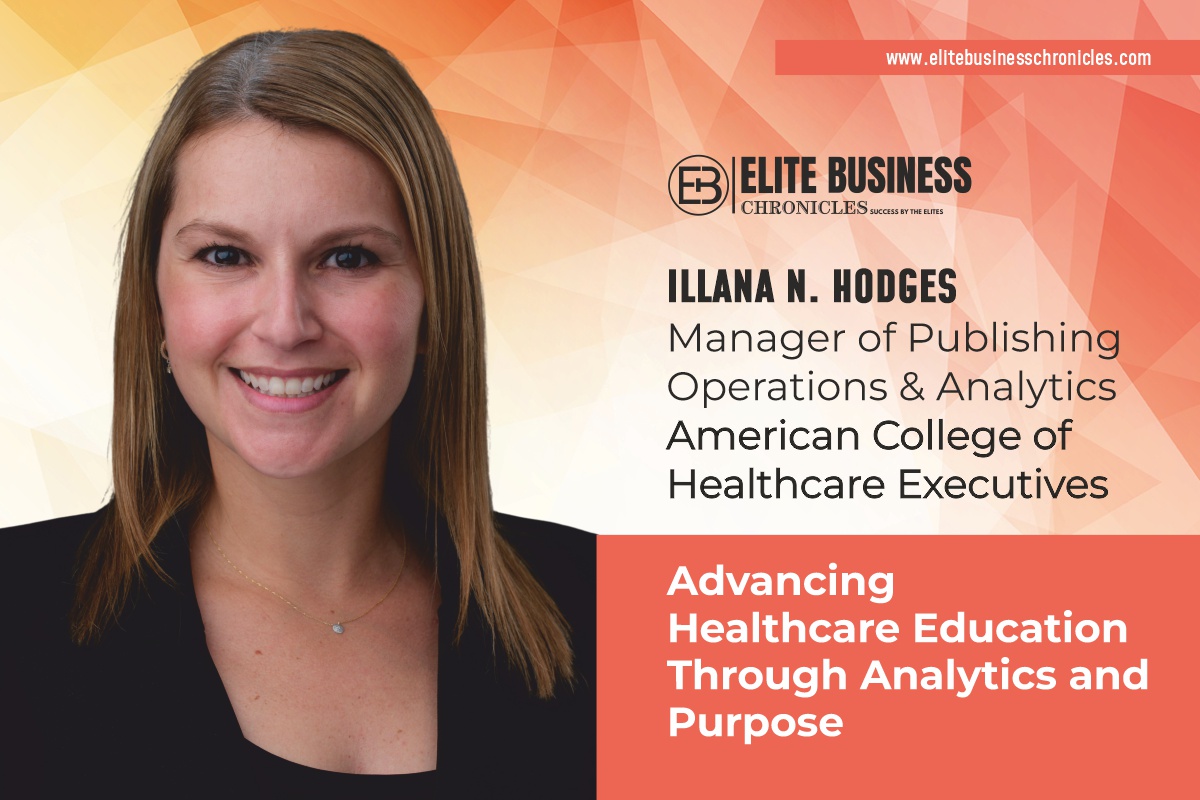
There is a quality in leaders that often goes unnamed. It lives somewhere between the analyst’s accuracy and the advocate’s sense of purpose, and it rarely develops along a straight line. It is shaped instead through an accumulation of unlikely detours, each one expanding a person’s aperture in ways a more predictable career could not have produced.
In the institutions responsible for developing the next generation of healthcare executives, this kind of leader carries uncommon weight. Illana N. Hodges, Manager of Publishing Operations and Analytics at the American College of Healthcare Executives (ACHE), built her professional identity at precisely that intersection.
A Foundation Built Across Disciplines
Illana began her academic life in physics, earning her Bachelor of Science from Indiana University, where she also had the opportunity to study abroad in Australia. The degree gave her more than technical knowledge. It gave her a language for complexity, a way of looking at problems that prioritized rigor, evidence, and precision above assumption.
Her early professional life reinforced that instinct. At EPIR Technologies, Inc., she worked alongside engineers and physicists on infrared photodiode research and supported proposal development for Small Business Innovation Research (SBIR) programs. The experience deepened her appreciation for interdisciplinary collaboration and introduced her to the discipline of translating highly technical work into proposals and communications capable of reaching a broader audience.
The pull toward larger questions eventually led her to pursue a Master of Public Policy at DePaul University. There, she earned the School of Public Service Degree Chair Award and took a second study abroad opportunity, this time in Brussels, which deepened her understanding of international policy and systems thinking. The move from physics to public policy was not a departure from her technical roots but an extension of them, applied now to the complexity of organizations and industries rather than materials and signals.

Before joining ACHE, she spent time in the defense and national security sector, leading innovation and research initiatives that supported small businesses and emerging technologies. That environment placed a premium on something she would draw on repeatedly in the years ahead: the ability to navigate complex stakeholder environments, connect innovation with real-world impact, and communicate strategic ideas clearly across significant organizational distance. It sharpened, in other words, the part of her leadership that operates best when the work is consequential and the margin for misalignment is narrow.
Each chapter, taken in isolation, might appear like a detour. Taken together, they assembled a professional foundation that few roles in healthcare leadership could have produced on a more conventional path. When Illana finally found the work that called on all of it, she recognized it immediately. “What excites me most about my role,” she says, “is the ability to combine analytical rigor with meaningful mission-driven work.”
A Mission Worth Measuring
In 2020, Illana joined ACHE as a Business Analyst. Over the years that followed, she grew into her current role as Manager of Publishing Operations and Analytics, a position that places her at the center of a complex operational network. Her responsibilities span analytics, forecasting, budgeting, and operational reporting for publishing initiatives, as well as cross-functional collaboration across finance, fulfillment, technology systems, and digital distribution.
The organization itself provided a critical part of the equation. ACHE is, in Illana’s view, one of the most respected professional associations dedicated to advancing healthcare leadership excellence. It supports executives, administrators, and emerging leaders through credentialing programs, educational publications, and leadership development initiatives. Its Annual Congress on Healthcare Leadership, she notes, stands as one of the premier gatherings for healthcare executives and thought leaders in the field. The combination of that scope and purpose created an environment where her analytical capabilities could serve something that extended well beyond operational efficiency.
What distinguishes ACHE as an institution, she observes, is its commitment to continuous learning and adaptability. Healthcare is constantly evolving due to changes in technology, policy, patient expectations, and workforce dynamics, and the organization’s ability to equip leaders with practical tools and relevant research to navigate those shifts keeps it meaningful across career stages. The culture she has experienced from inside is one she describes as genuinely collaborative and consistently oriented toward the professionals it serves.
For Illana, the alignment between her capabilities and the institution’s mission is not incidental. It is the point. “Healthcare leadership ultimately affects people’s lives,” she says, “and knowing that my work contributes to stronger educational resources and better-informed leaders gives my work deeper meaning.”

The Change Manager
No professional framework for adaptability is complete without pressure testing. For Illana, that test arrived in the form of overlapping operational transitions that required managing not just technical complexity but organizational trust.
The most consequential involved supporting the migration from a legacy association management system to Salesforce while simultaneously maintaining accurate financial and operational reporting across departments. The effort required extensive coordination, data validation processes, and workflow redesigns, all executed without disrupting the reporting continuity the organization depended on.
A separate transition, the move to a new digital distribution partner, introduced a different order of challenge: backend system setup and publication metadata migration, where the need for precision was absolute and speed had to be weighed carefully against reliability.
What Illana took from both experiences reaches beyond technical. Organizational change, she learned, is rarely about the system itself. It is about the people navigating the transition alongside it. Different departments, different roles, and different relationships to new technology each carry their own friction and uncertainty.
The leader’s responsibility is not simply to manage migration but to manage the meaning people make of it. “All stakeholder experiences change differently,” she says, “and successful leaders must create environments where people feel informed, supported, and empowered throughout the process.”
Patience, empathy, and clear communication emerged from these episodes not as aspirational values but as tested operational tools. The experience also confirmed, for Illana, that the leaders most capable of guiding organizations through transition are those who can hold both the technical rigor of the process and the human reality of the people involved in it at the same time.
Impact on the Record
Among the professional contributions Illana considers most meaningful, one stands apart for its organizational scale. The strategic rebranding of Health Administration Press to ACHE Learn required more than a change of name. It demanded the alignment of analytics, reporting structures, and publishing operations with a broader organizational vision, while ensuring continuity across systems and stakeholder groups throughout the process. Illana played a central role in that alignment, ensuring the data infrastructure underpinning the new direction was sound and that operational reporting remained accurate through the transition.
More broadly, her work at ACHE has involved building forecasting models and analytics reports that support strategic planning, revenue optimization, and program effectiveness. These contributions rarely surface in public narratives about organizational leadership, but they form the operational spine of how data-driven decisions get made at an institutional level.
For Illana, this is where the convergence of her technical background, policy training, and healthcare mission makes itself most visible: not in a single project, but in the quiet consistency of the systems that allow an organization to plan with confidence.
The professional community has taken note. Illana has received the Alton E. Pickert Achievement Award and holds PMP certification. She has also been recognized through a Forty Under 40 distinction; honors she describes as reflecting both professional excellence and a commitment to service-oriented leadership.
Alongside these individual recognitions, she points to mentorship and cross-functional collaboration as contributions she holds in equal regard. Supporting emerging professionals and creating conditions where teams can do their best work are, in her telling, dimensions of leadership that do not always appear on performance records but shape organizations in lasting ways.
The Philosophy of the Future
Illana describes her leadership philosophy through four principles she holds consistently across contexts: integrity, accountability, collaboration, and adaptability. Each carries specific weight in her telling. “Integrity is foundational,” she says, “because trust is essential in any professional environment.”
Accountability means taking ownership of both successes and setbacks while maintaining a solutions-oriented mindset. Collaboration reflects her conviction that diverse perspectives strengthen organizations and that the best outcomes emerge when teams work together openly and respectfully. Adaptability, she argues, is not simply a response to disruption but a prerequisite for anyone hoping to lead in an industry that does not wait for the slower thinker.
That principle connects directly to her views on technology in healthcare. Illana believes that modern tools, among them predictive analytics, artificial intelligence, and digital health platforms, are transforming how healthcare organizations operate and plan.

In her experience, these technologies enhance reporting accuracy, improve communication, and strengthen the analytical foundation for strategic decisions. But she is precise about where the limits are. Successful technology adoption requires investment in training, change management, and ethical oversight to ensure that tools remain accessible, effective, and aligned with patient-centered values. Technology, in her telling, is only as good as the organizational culture prepared to use it.
For those entering the field, Illana points to a set of qualities she considers foundational: strong communication skills, ethical decision-making, adaptability and resilience, strategic thinking, data literacy, collaboration and relationship-building, and empathy. Healthcare leaders, she argues, must hold all of these simultaneously, because the industry demands that innovation, financial sustainability, workforce challenges, and patient-centered care be balanced at once, and rarely in sequence.
Her vision for the years ahead is consistent with the work she has already built. She sees growing opportunity at the intersection of analytics, technology, and leadership strategy, and she intends to deepen that work within ACHE, expanding the organization’s analytical capabilities and contributing to the infrastructure that helps healthcare leaders make better decisions in an increasingly complex environment.
For aspiring professionals, she offers counsel grounded in her own accumulation of unlikely detours: “Leadership is not about having all the answers. It is about continuously learning, supporting others, and creating positive impact.