

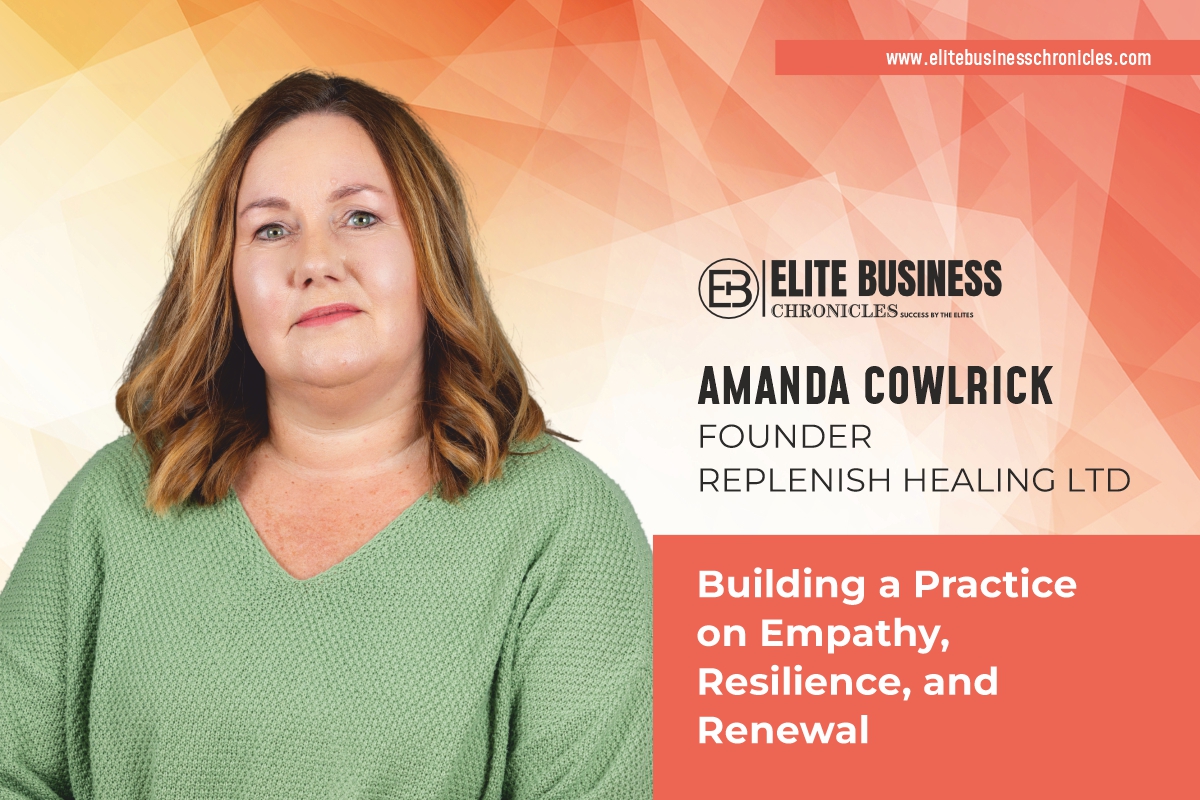
Some callings do not announce themselves with a single dramatic moment. They arrive quietly, recede when life pulls in another direction, and then return with a patience that outlasts every detour. The truest vocations are not chosen once. They are chosen repeatedly, each time with a deeper understanding of why the answer was always the same.
This is the rhythm that has defined the career of Amanda Cowlrick, Founder of Replenish Healing Ltd. Based in New Zealand, Amanda has built a practice that weaves together Homeopathy, Reiki, and Atua Healing to support individuals and organisations in restoring balance across body, mind, and energy. Her path to this work was neither linear nor sudden. It was a decades-long conversation between professional ambition and an instinct she could not permanently set aside.
She reflects on the moment in 2018 when everything aligned, describing it as a time when “it all just felt right, and that this is where I was meant to be.” For Amanda, that realisation was not a beginning so much as a homecoming.
A Path That Kept Returning
Amanda Cowlrick’s connection to natural health began early. She was drawn to homeopathy and Reiki from a young age, and both modalities played a meaningful role in her own wellbeing. Yet the path was far from direct. In her early twenties, while working in childcare, she stepped away from natural approaches, lacking the information and remedies to maintain them in a fast-paced environment that demanded quick solutions.
Years later, in her thirties, Amanda reconnected with this part of her life. She met a teacher named Carmel and began Atua Healing Stage One. But a disconnect lingered, and she stepped away from the training to focus on running businesses with her then-partner. After their separation, she continued in the field of contract work, helping small and medium-sized enterprises navigate their operations.
It was in 2018 that the pull returned with unmistakable clarity. The timing aligned, the teachers appeared, and the flow into Reiki and Atua Healing felt entirely organic. Homeopathy followed, and before she fully realised the scope of her commitment, she was enrolled in a three-year course. The decision had happened so quickly that she had not yet discussed it with her new partner, who, fortunately, was completely supportive of the shift in direction.
At that point, everything fell into place. The business name, Replenish Healing, came to her during this period, arriving with the same organic quality that defined the rest of the transition. What had once felt like a recurring pull had finally become a permanent foundation.
Three Modalities, One Philosophy
At the heart of Replenish Healing is a distinctive integration of three modalities: Homeopathy, Reiki, and Atua Healing. Each discipline, in Amanda’s view, is effective on its own, but the combination offers something greater. It is a question she has been exploring for some time, and her clinical experience has shaped a clear perspective on how these therapies complement one another.
Amanda describes the interaction between these therapies as one that can lead to a noticeably faster recovery time. In her experience, reducing stress and emotional blockages through Reiki makes clients more receptive to the healing effects of homeopathic remedies. Atua Healing, which works with seven distinctive levels of energy and uses muscle testing to identify blockages across different age periods, functions alongside homeopathy to address what Amanda considers the root cause of an issue, ensuring lasting results.
According to Amanda, this holistic approach often results in improved vitality, increased resilience, and a more profound sense of balance and harmony within the body and mind. Clients at Replenish Healing, she notes, frequently report feeling rejuvenated, experiencing reduced symptoms, and achieving a deeper state of wellness more quickly than with a single modality alone.
The reach of these modalities extends beyond the treatment room. Amanda offers distance Reiki sessions, making the practice accessible to clients regardless of location. One client, after receiving distance Reiki arranged entirely through text message, offered feedback that captures the simplicity and impact of the work: “Thank you, I feel a lot better.” For Amanda, these moments of quiet confirmation are among the most rewarding aspects of her practice.
Bridging Boardrooms and Balance
Amanda’s earlier career in corporate finance and administration gives her an unusual vantage point. She understands the pressures of professional life firsthand, and that experience shapes how she designs wellness offerings for today’s workforce.
The corporate landscape, she observes, has changed considerably since she worked within it, and largely for the better. There is now greater awareness around mental health and more encouragement for staff to take time off for holidays. This shift has created space for people to attend appointments and to explore modalities that go beyond quick fixes. Today’s professionals, in Amanda’s view, are more comfortable seeking out holistic approaches that are not based on quick-fix solutions, but on what she describes as deep-seated long-term well-being.
Currently, Replenish Healing offers on-site visits to companies for seated Reiki sessions, meditation instruction, and workshops in basic acute homeopathy. These skills, in Amanda’s view, help staff manage their health naturally and holistically. Reiki, she notes, is particularly well suited to the corporate environment. Sessions can be offered in the evening, the client remains fully clothed unlike a massage, and the practice can also be delivered as a distance healing session, making it especially appealing to busy professionals. After a session, Amanda reports, people feel more relaxed and often report sleeping better.
Yet Amanda is candid about the challenges. She is still in the early stages of reaching out to corporate clients and acknowledges that some resistance to holistic approaches persists in certain business cultures, though this is slowly disappearing. A long-term goal is to collect measurable data from her corporate partnerships to demonstrate the tangible benefits of integrated wellness support for the benefit of their staff.
One of the biggest misconceptions corporate leaders hold, in Amanda’s view, is that holistic healing is quackery and expensive. She points to research by David E. McManus, whose paper, “Reiki is better than placebo and has broad potential as a complementary health therapy,” supports the case for bringing Reiki into the workplace.
Homeopathy, she adds, offers a reasonably affordable way to help employees manage their health. If an illness is caught early, Amanda believes homeopathy can quicken the body’s response toward homeostasis, meaning fewer days of absenteeism. She recalls working with a client who suffered an accident involving a nail through the finger. The client reached out immediately, sent photos, and Amanda provided the remedy needed. In her account, there was full improvement within a day.
A Broader Scope for Wellness
While organisations are re-evaluating mental health support in the wake of the pandemic, Amanda believes there is still a need for a broader scope of what could be offered to staff. In her view, it is easy for organisations to play it safe and stay within restrictive boundaries of what is available, but this can limit access for staff due to cost and whether the offered mental health approach resonates with them personally.
Having a range of modalities available, Amanda argues, gives more scope for staff to find something that works for them in a more natural way. This includes energy-based therapies such as Reiki. She believes that natural and energy-based therapies offer a more cost-effective and gentler approach than some other modalities, with benefits to the company that include fewer sick days and a workforce better equipped to manage stress and mental health in a meaningful way.
Empathy Forged in Crisis
Amanda’s capacity for compassionate, structured leadership was tested during one of the most challenging periods in recent memory. During the pandemic, while still completing her studies, she secured a role in team coordination and support services in New Zealand.
The environment was charged with tension. Government mandates around vaccination had created deep divisions. Many of the people Amanda worked alongside had chosen to remain unvaccinated and had lost their jobs in other fields as a result. Empathy, she recognised, had to be at the forefront of every interaction, not only with her team but also with the people they were calling. She needed to be available when a particularly difficult call or a personal situation arose.
During this time, Amanda began offering meditations for her team. While the practice did not resonate with everyone, those who chose to embrace it reported improved wellbeing and feeling more connected with their teammates. It was a small intervention with a meaningful impact, reinforcing her belief in the value of holistic practices even in high-pressure professional settings.
At the same time, Amanda graduated and launched Replenish Healing in 2021, in the middle of the pandemic. The dual demands of supporting clients and navigating the pressures around medical decisions required a stance grounded in non-judgment.
“I have never judged someone for the choices they made around any medical or personal decisions as my place is to support and listen,” she says. That principle, forged under pressure, remains a cornerstone of her practice today.
The pandemic also cemented a personal discipline that has become essential to her work: daily self-Reiki. What began as a necessary coping mechanism during a period of high emotional demand evolved into a daily habit that helps her stay focused on her goals for her clients and for Replenish Healing. She maintains some flexibility in her schedule to accommodate last-minute bookings or client changes, but the self-Reiki practice is non-negotiable.
The Architecture of Trust
For Amanda, credibility in the corporate wellness space is built on transparency, qualifications, and a commitment to long-term partnerships. When she works with any organisation, she needs to know the partnership will be beneficial for both sides. Part of that, she explains, is being honest about what she can and cannot do and being open about her pricing structure.
She is clear that a long-term partnership works better for both staff and the company. This approach allows her to build relationships with employees over time, establishing the trust needed for open and frank discussions. That trust, in turn, enables her to tailor solutions for each staff member, whether through Reiki, Atua Healing, Homeopathy, or a combination of modalities.
Maintaining professional registrations for both Reiki and Homeopathy is a central part of this trust architecture. These registrations ensure that any corporation hiring her knows it is engaging a fully qualified practitioner who is maintaining her continuing professional development hours and staying current with new research. “Staying up to date and registered helps me maintain my credibility and builds trust,” she says.
There is also a layer of vigilance woven into her daily communications. Amanda is mindful of what she says in emails and on calls, as holistic practitioners in New Zealand must abide by the New Zealand Advertising Standards Authority regarding claims about the benefits of their modalities. She is conscious that some individuals may attempt to catch practitioners making statements that could be used to discredit them or their therapies in the media. This awareness, drawn directly from her pandemic-era experience, informs the structure she brings to every professional interaction.
Lessons Across Chapters
Amanda’s career has spanned childcare, hospitality, corporate finance, SME contract work, and holistic health. From these varied chapters, certain entrepreneurial principles have endured.
The most important lesson, in her view, is to surround yourself with people who build you up, who possess complementary skills, and who refuse to take “no” for a final answer. She has encountered many people who are quick to offer opinions on what she is doing and whether it will succeed. These, she observes, tend to be people who do not take risks in their own lives and therefore do not understand the depth and planning that goes into even looking at setting up a business.
She has a ready response to unsolicited scepticism, a quick “thank you but I am not looking for an opinion on what I am doing. I am working with professionals in this field.” That boundary, she notes, works well when you have surrounded yourself with people who genuinely know what they are doing.
Amanda also emphasises honesty about the limits of one’s knowledge, the value of listening to people who have been there before you, and the willingness to learn what worked and what did not, as this can save both time and money.
What worked when she first entered business looks considerably different now, with a greater focus on online advertising through platforms like Facebook, Instagram, and LinkedIn, and the growing role of AI tools such as ChatGPT and NotebookLM. The landscape evolves, but the fundamentals of transparency and resourcefulness remain constant. Her advice is simple: find the right people, learn from them, and then just go for it.
Redefining Workplace Wellness
Amanda’s vision for the future of workplace health extends well beyond offering a menu of services. She defines it as a workplace built on respect for its staff, open dialogue from managers, and a common goal of personal responsibility for staff wellbeing, supported by the company through offering integrated holistic therapies alongside medical insurance and other benefits.
She is particularly attentive to the role of management in organisational wellness. In Amanda’s view, staff often leave their managers rather than their companies. When someone in a managerial position undermines, dismisses, or overworks staff, or takes credit for a team member’s work, the impact on the mental health of employees can be lasting.
In these situations, Amanda believes that working with managers through personal transformation, showing them positive ways to empower their staff, alongside initiatives such as group meditations and wellness days where staff are given a day to go out, disconnect from phones and computers, and do something rewarding for themselves, can create meaningful change.
For companies exploring holistic wellness for the first time, Amanda recommends starting with an event day where a range of different natural health practitioners are brought in so staff can discover what is available to them. The practitioners, she stresses, need to be qualified and registered in their chosen modalities and should also have public liability and professional indemnity insurance. These requirements protect the company if any issue arises from advice given by a practitioner.
From there, companies can identify the modalities that best align with their business culture. Reiki, she points out, is particularly well suited because it has a non-religious background, can be done in a chair with the client fully clothed, takes only fifteen to thirty minutes, and is supported by research demonstrating its potential to reduce stress and anxiety. Incorporating basic homeopathy training into workplace health and safety, she adds, could reduce absenteeism by allowing minor incidents and early-stage illness to be addressed on site, while also slowing the spread of illness to the rest of the staff.
The Meaning of Replenish
The word “Replenish” carries deep personal significance for Amanda Cowlrick. In a fast-paced world where many people feel constantly drained by the demands of work, family responsibilities, and everyday pressures, she wanted to create a space where individuals could pause, restore their energy, and reconnect with what truly matters to them.
Replenish Healing, she explains, was founded on the idea that healing does not always need to be dramatic or complex. Sometimes it simply begins with giving yourself permission to rest, reflect, and care for your own wellbeing. Her own journey has included periods where she needed to step back, reassess her direction, and reconnect with her purpose. Like many people, she has experienced those moments where the demands of life required a deliberate pause before she could move forward with renewed clarity.
Today, as a healer, businesswoman, and leader, the word represents renewal, balance, and the opportunity for transformation. “It is about helping people rediscover their inner strength and move forward with greater clarity and vitality,” she says.
Looking ahead, Amanda plans to extend this philosophy through Replenish Healing Retreats, a venture designed to offer anyone in need of time out the chance to disconnect for a while and reconnect with who they are.
A Legacy of Renewal
Amanda Cowlrick’s journey from corporate leadership into holistic health reflects a growing movement toward more integrated approaches to wellbeing. As the founder of Replenish Healing, she brings together a background in business, team leadership, and natural health practices to create spaces where individuals and organisations can pause, recalibrate, and restore balance.
Through modalities such as homeopathy, Reiki, and Atua Healing, Amanda’s work focuses on supporting people who are ready to take an active role in their wellbeing and explore sustainable paths toward long-term health.
As workplace culture continues to evolve and conversations around mental health and resilience deepen, Replenish Healing represents a thoughtful bridge between professional life and personal restoration reminding us that when people are supported to replenish their energy, clarity and purpose often follow.