
The speed of technology has never been the problem. The problem has always been trust. Every generation of innovation, from the first industrial machines to the rise of artificial intelligence, has carried the same underlying question: can the systems we build be governed with the same ingenuity that created them? It is a question that most industries answer too late, after the damage is done, after the fraud has settled, after the public’s faith has already eroded.
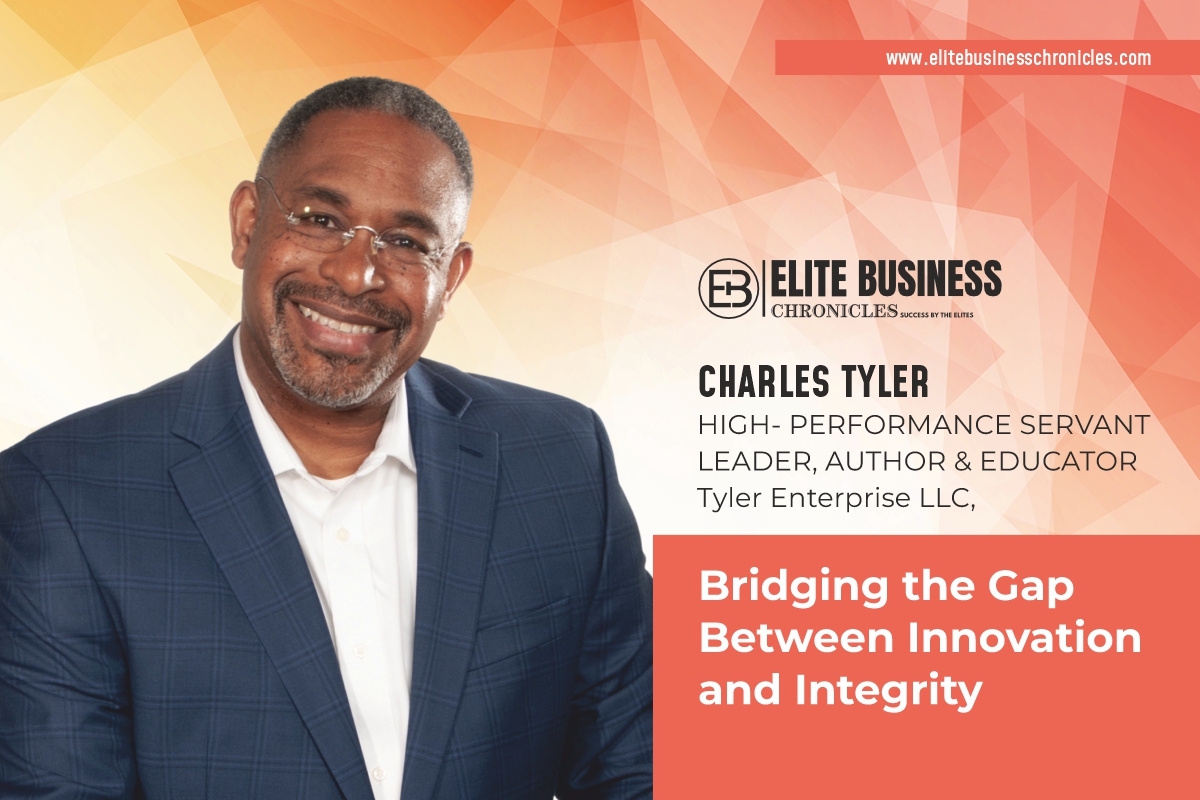
For Charles Tyler, the answer cannot wait. An author, educator, and multidisciplinary leader whose career spans more than two decades, Tyler operates at a rare intersection: the place where leadership development, blockchain ethics, operational excellence, and emerging technology converge. Where others see separate disciplines, he sees a single, interconnected challenge.
“Leadership today cannot exist inside a single field of expertise,” Tyler says. “The modern leader must understand people, systems, ethics, and innovation simultaneously.”
That conviction has driven a career defined not by specialization but by integration. Tyler has built his professional identity across education and mentorship, Lean Six Sigma and process improvement, blockchain governance, artificial intelligence ethics, coaching, and strategic marketing. Each discipline informs the others. Each one, in his view, is incomplete without the rest. A multidimensional leader, he argues, does not simply adopt technology. They ask whether it serves human progress, strengthens institutions, and creates sustainable value. His work sits at that intersection.
His central contribution to the conversation around emerging technology is Tyler’s 8 Pillars of Trust for Blockchain & Crypto™, a framework designed to evaluate digital projects through the lens of trust, transparency, responsibility, and long-term value. But to understand the framework, one must first understand the foundation it was built on: a lifetime spent in classrooms, coaching rooms, and the quiet work of helping people think more clearly about the world around them.
The Educator’s Foundation
Before blockchain, before AI governance, before frameworks and certifications, there was teaching. Tyler’s career began in education, where he spent more than twenty years working as an educator and mentor. That experience shaped everything that followed.
In classrooms and coaching sessions, Tyler developed a conviction that has never wavered: tools change, but people remain the central factor in whether systems succeed or fail. Technology could automate processes and accelerate output, but it could not replace the human elements that make organizations function. Confidence, discipline, critical thinking, and the willingness to grow.
His work later expanded into operational excellence through Lean Six Sigma and process improvement. That experience gave him a structured way to think about systems, efficiency, and measurable performance. It trained him to look beyond surface-level outcomes and ask deeper questions about root causes and sustainable improvement.
Across those two decades, Tyler observed several constants that held true regardless of how the technological landscape shifted. Belief matters. When people develop confidence in their ability to learn and adapt, their performance often exceeds their initial expectations. Mentorship matters. The presence of a teacher or coach who believes in someone’s potential can alter the trajectory of a life. Integrity matters. Short-term success built without it rarely endures. And curiosity matters. Individuals who remain curious continue growing long after formal education ends.
“Technology evolves quickly,” Tyler notes. “Human nature evolves slowly.”
Technological transformation changes tools and industries, but the underlying drivers of human progress remain remarkably consistent. Leadership, mentorship, and purpose continue to shape the outcomes of individuals and organizations.
That understanding became the lens through which Tyler approached every subsequent chapter of his career. When he moved into operational excellence through Lean Six Sigma, it was with the knowledge that process improvement means nothing if the people running those processes are not developed alongside them. When he later engaged with blockchain and AI, it was with the same insistence on placing human judgment at the center.
With extensive experience, he applies Lean and Six Sigma methodologies to drive operational excellence. Tyler also has experience as a senior operations executive, leading large-scale municipal operations, asset management, and service delivery. He also brings experience in logistics and inventory control with Saks Fifth Avenue.
Tyler’s commitment to continuous learning is reflected in his own academic path. He has pursued professional development through programs at Harvard, Duke, Vanderbilt, and INSEAD. Some of those institutions emphasize analytical rigor. Others focus on entrepreneurship, global economics, or technological transformation.
That diversity of intellectual exposure reinforced two principles he now considers foundational. The first is that innovation rarely happens inside isolated silos. It emerges when ideas from different fields intersect. The second is humility. Global education reinforces the understanding that no single institution or individual possesses all the answers. Continuous learning is essential for anyone who wants to remain effective in a rapidly evolving world.
Building a Trust Architecture
The digital economy advanced faster than the trust structures designed to support it. That observation sits at the heart of Tyler’s most significant intellectual contribution.
Blockchain and cryptocurrency introduced revolutionary concepts: decentralized systems, permissionless networks, and programmable value with the potential to reshape finance and digital ownership. At the same time, the industry experienced waves of speculation, fraud, misinformation, and regulatory uncertainty. Technical innovation was accelerating, but ethical frameworks and trust models were lagging behind.
Tyler saw participants across the ecosystem asking the same questions. How do we evaluate projects responsibly? How do we build transparency into decentralized systems? How do individuals protect themselves in a rapidly evolving landscape?
Tyler’s 8 Pillars of Trust for Blockchain & Crypto™ emerged from that gap. Rather than focusing solely on technical capability or market speculation, the framework encourages deeper evaluation of governance, transparency, sustainability, and ethical intent. It was designed to provide a structured way to evaluate digital projects through the lens of trust and long-term value. In Tyler’s view, technology alone does not build trust. Systems, behavior, and accountability do.
The framework also reflects a broader philosophy that Tyler applies beyond the blockchain space. He argues that trust is a strategic asset, not a soft value, and that organizations can operationalize it by aligning leadership behavior with stated principles. Governance structures that encourage openness and ethical decision-making, clear communication channels, responsible data practices, and transparent reporting all contribute to institutional trust.
Another critical factor, in Tyler’s assessment, is psychological safety. Employees must feel comfortable raising concerns, asking questions, and sharing ideas without fear of retaliation. When that safety is absent, trust erodes from the inside regardless of what the organization projects externally.
Trust also grows, Tyler argues, when organizations consistently deliver on commitments. Reliability, fairness, and integrity create credibility over time. Trust is not the product of a single gesture or announcement. It is the accumulation of consistent behavior across every level of the organization.
“Trust is not built through messaging alone,” Tyler says. “It emerges through consistent action.”
That sentence captures the distinction Tyler draws between organizations that talk about integrity and those that embed it into their operating systems. Many organizations, he observes, speak about integrity as a value statement on a wall. In practice, however, systems often reward speed, scale, and profit above all else. When incentives conflict with principles, the system wins.
Institutionalizing integrity requires structural alignment. Leaders must design processes that reward transparency, accountability, and long-term thinking. Governance models, decision frameworks, and performance metrics should all reflect those values. Continuous growth also needs to be operationalized. Learning cannot be treated as a one-time training program. Organizations must build cultures where education, reflection, and adaptation are ongoing expectations.
Tyler’s own career reflects this principle. He has pursued certifications and studies across blockchain, artificial intelligence, leadership, operational excellence, and coaching because, as he sees it, the world does not stand still and knowledge must evolve with it. Leaders who institutionalize growth and integrity create environments where learning is expected, ethical behavior is protected, and accountability is visible. When those principles become part of the operating system of an organization, they stop being aspirational ideas and start becoming everyday practices.
Systems, Data, and Conscience
Tyler’s background in Lean Six Sigma gave him the discipline of measurement, analysis, and evidence-based decision-making. His subsequent studies in artificial intelligence and fintech expanded those capabilities further. Today, organizations can process massive datasets and uncover patterns that would have been impossible to detect decades ago. But Tyler is careful to draw a line between what data can do and what it cannot.
“Data provides clarity,” Tyler says. “Leadership provides direction.”
Every algorithm, model, and decision framework reflects human choices. People determine what data is collected, what metrics are prioritized, and what outcomes are valued. That means leadership carries a profound ethical responsibility even in the most data-driven environments. Data-driven systems can increase efficiency, but they can also reinforce bias or obscure accountability if they are not designed thoughtfully. The role of the leader, in Tyler’s framing, is to integrate analytical precision with moral awareness. When leaders combine analytical rigor with ethical responsibility, they create systems that are both intelligent and trustworthy.
Tyler’s view on artificial intelligence governance centers on four foundational principles. The first is transparency, ensuring that stakeholders understand how AI systems influence decisions and outcomes. The second is accountability, requiring that leaders remain responsible for the consequences of technological choices rather than delegating that responsibility entirely to algorithms. The third is fairness, demanding that systems be evaluated for potential bias and unintended consequences. The fourth is human oversight, preserving meaningful human involvement in critical decisions that affect people’s lives.
“Technology should expand human capability, not replace human conscience,” he says.
When organizations adopt governance frameworks rooted in these principles, Tyler argues, AI can become a powerful tool for progress rather than a source of harm. Technology should amplify human capability while preserving human dignity.
This perspective also reshapes how Tyler thinks about continuous improvement. Traditional Lean Six Sigma focused on process optimization, waste reduction, and operational efficiency. Those principles remain valuable, but Tyler argues that modern organizations must apply them within a broader technological environment. Automation and AI introduce new layers of complexity. Continuous improvement today involves both human and digital systems.
Leaders must ask deeper questions: how do processes interact with automated systems? How does data flow across platforms? How does technology affect employee roles and responsibilities? Organizations must evaluate not only operational workflows but also data quality, algorithm performance, system reliability, and ethical implications. Continuous improvement, in Tyler’s framing, is no longer limited to process efficiency. It includes technological adaptability, ethical oversight, and organizational learning.
Tyler has been recognized for this integrative approach with the Continuous Improvement Professional Award, a distinction that reflects his commitment to evolving the discipline beyond its traditional boundaries.
The Communicator’s Evolution
For most of Tyler’s career, marketing was not an area where he held formal expertise. That changed as his work around the 8 Pillars of Trust began to grow. He realized that understanding marketing was essential for communicating complex ideas effectively and responsibly.
Over the past two years, Tyler intentionally pursued professional education through the American Marketing Association, earning the Marketing Management Certification, a credential Tyler describes as a point of particular pride, along with additional marketing-related credentials. The goal was not to become a traditional marketer. It was to learn how communication, positioning, and strategic messaging influence how people understand topics such as blockchain, trust, and emerging technology.
Studying marketing helped Tyler better understand how to present the 8 Pillars of Trust in a way that resonates with both technical and non-technical audiences. It strengthened his ability to translate complex technological concepts into frameworks that people can actually apply in their decision-making. Marketing, when practiced responsibly, can become a powerful tool for education and clarity rather than hype.
Tyler views this as a natural extension of his broader leadership philosophy. Just as operational excellence focuses on improving systems and education focuses on developing people, marketing helps ensure that meaningful ideas are communicated clearly and responsibly. That understanding has become an important addition to his capabilities as he continues to expand his work in blockchain strategy, trust frameworks, and leadership development.
This evolution also connects to a larger responsibility Tyler sees for educators and thought leaders. When new technologies emerge, early adopters move quickly while the broader public struggles to understand the implications. That gap can lead to misinformation, fear, or misuse. Educators and thought leaders, Tyler argues, have a responsibility to translate complex ideas into clear, accessible knowledge. That does not mean oversimplifying technology. It means explaining it responsibly, highlighting both opportunities and risks.
Thought leaders must also emphasize ethical awareness. Innovation without ethical reflection, Tyler warns, can produce powerful systems that society is not prepared to govern. The role of educators today extends beyond teaching technical concepts. It includes helping people develop critical thinking skills, ethical awareness, and the ability to evaluate emerging technologies for themselves. When knowledge spreads responsibly, Tyler believes, trust can grow alongside innovation rather than trailing behind it.
The Discipline of Wisdom
Tyler has been recognized with honors including Most Inspirational Author and Learning Innovator of the Year. He views these awards as signals that people are paying attention to his work and ideas, and as validation that his contributions are having an impact. At the same time, they reinforce the importance of remaining grounded and focused on service.
Thought leadership carries influence, Tyler observes. With influence comes the responsibility to communicate responsibly, remain open to learning, and stay aligned with the values that originally guided the work. Recognition, in his view, should not change the mission. It should strengthen the commitment to it.
That mission is oriented toward the future. Tyler envisions a next generation of innovators who operate at the intersection of technology, ethics, and human development. Leadership in the coming decades, he believes, will require a deeper understanding of how emerging technologies affect societies, economies, and institutions. Technical expertise will remain important, but ethical awareness and global perspective will become equally essential. Education, Tyler argues, will play a central role in preparing these leaders. Institutions must teach not only technical skills but also critical thinking, ethical reasoning, and adaptability.
Innovators who combine these capabilities, in Tyler’s view, will be able to design technologies that solve real problems while respecting human values.
Central to this vision is a concept Tyler calls intellectual self-mastery. Modern professionals operate in environments defined by rapid change, constant information flow, and evolving expectations. Technical knowledge alone is no longer enough. Professionals must also develop mental discipline: the ability to think critically, remain resilient during uncertainty, and adapt to new challenges.
Intellectual self-mastery, as Tyler defines it, includes emotional awareness, curiosity, and the ability to reflect on one’s own thinking. It encourages professionals to question assumptions, refine their perspectives, and remain open to growth. In his coaching and writing, Tyler emphasizes mindset development because technology does not eliminate the need for personal development. In many ways, it makes it even more important.
“Technical expertise builds capability,” Tyler says. “Intellectual self mastery builds wisdom.”
Professionals who combine both, in his assessment, become more adaptable, more thoughtful, and more effective leaders. They are equipped not only to build systems but to ask whether those systems serve human progress, strengthen institutions, and create sustainable value.
Tyler’s hope is that future leaders will see trust, integrity, and responsibility not as constraints on innovation but as foundations that make innovation sustainable. It is the same principle that has guided his own career across education, operational excellence, blockchain ethics, AI governance, and strategic communication. Each discipline different in method. All of them, in Tyler’s telling, converging on a single question: whether the systems we build can be trusted to serve the people they are meant to help.
“Technology moves quickly,” Tyler says, “but the future ultimately belongs to those who can guide it with wisdom.”