

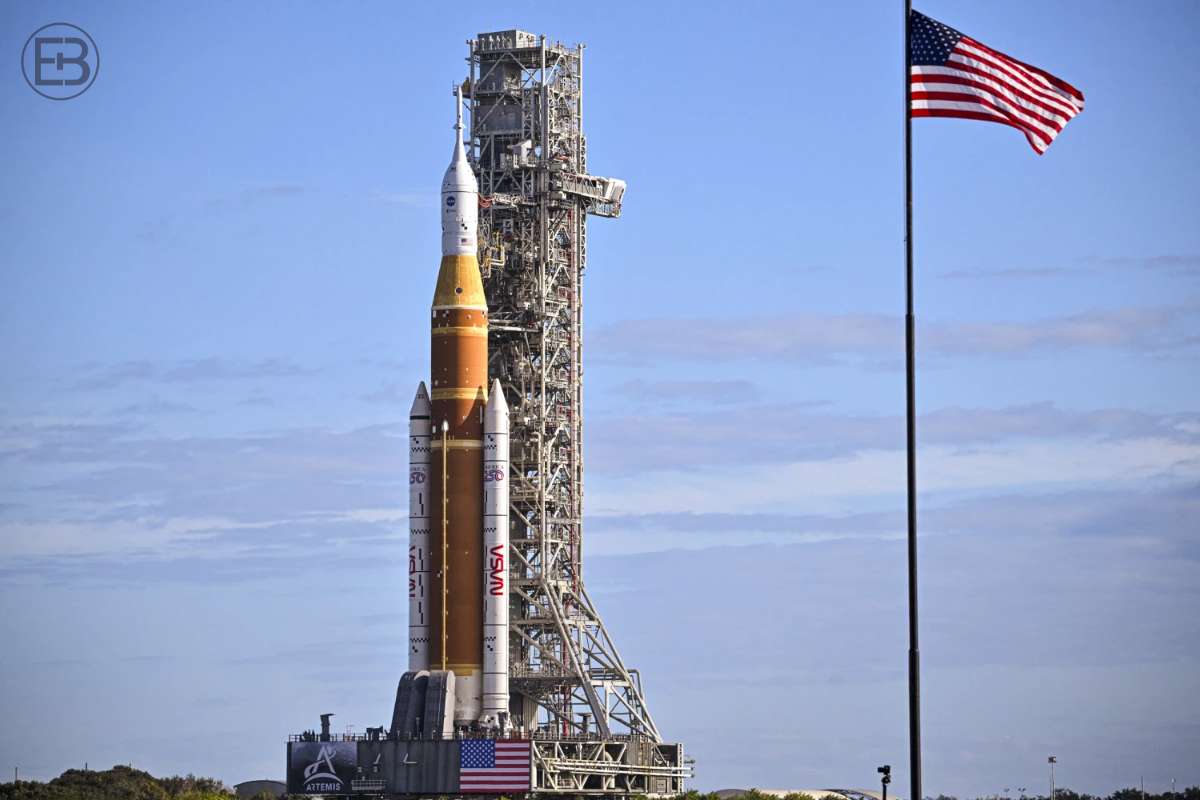
NASA officials have completed a major safety review for the upcoming crewed lunar flyby mission and announced a new target launch window for the historic flight. During a press conference on Thursday, the agency confirmed that the mission known as Artemis II is now scheduled to lift off on April 1 at 6:24 p.m. ET, pending final preparations.
If the launch does not occur on that date, several backup opportunities are available throughout the month. Additional launch windows are currently planned for April 2, 3, 4, 5, 6 and April 30.
The announcement followed a critical two-day evaluation known as a Flight Readiness Review (FRR). During this process, mission leaders and engineers analyze whether every major component including the rocket, spacecraft and ground infrastructure is fully prepared for launch. The review is a key milestone before the mission can receive final approval to proceed.
However, officials declined to provide a precise numerical estimate of the mission’s overall risk. In the past, NASA publicly shared statistical projections that measured the probability of “Loss of Mission” or “Loss of Crew,” particularly during the era of the Space Shuttle program.
Before the uncrewed test flight of Artemis I in 2022, NASA estimated there was roughly a 1-in-125 chance that the spacecraft could be lost. The same spacecraft design the Orion spacecraft will carry the four astronauts on the Artemis II mission.
John Honeycutt, who leads the mission management team, said assigning precise probabilities can be misleading. He noted that such estimates often rely on assumptions rather than extensive real-world data. Because Artemis II will mark only the second flight of NASA’s new heavy-lift rocket, the Space Launch System, engineers have limited historical data to calculate exact risk figures.
Honeycutt explained that the chances of everything going perfectly are likely better than during the rocket’s first flight but still uncertain. As a result, NASA officials are deliberately avoiding putting a single probability number on the mission’s success or failure.
Lori Glaze, acting associate administrator for NASA’s Exploration Systems Development Mission Directorate, echoed that cautious approach. She emphasized that thousands of engineers, scientists and technicians have spent years preparing for the mission.
According to Glaze, the extensive preparation and testing reflect the enormous effort behind the test flight, which will send astronauts around the Moon and back to Earth for the first time in more than five decades, a major step toward future lunar landings.